






 LIGHT
 2
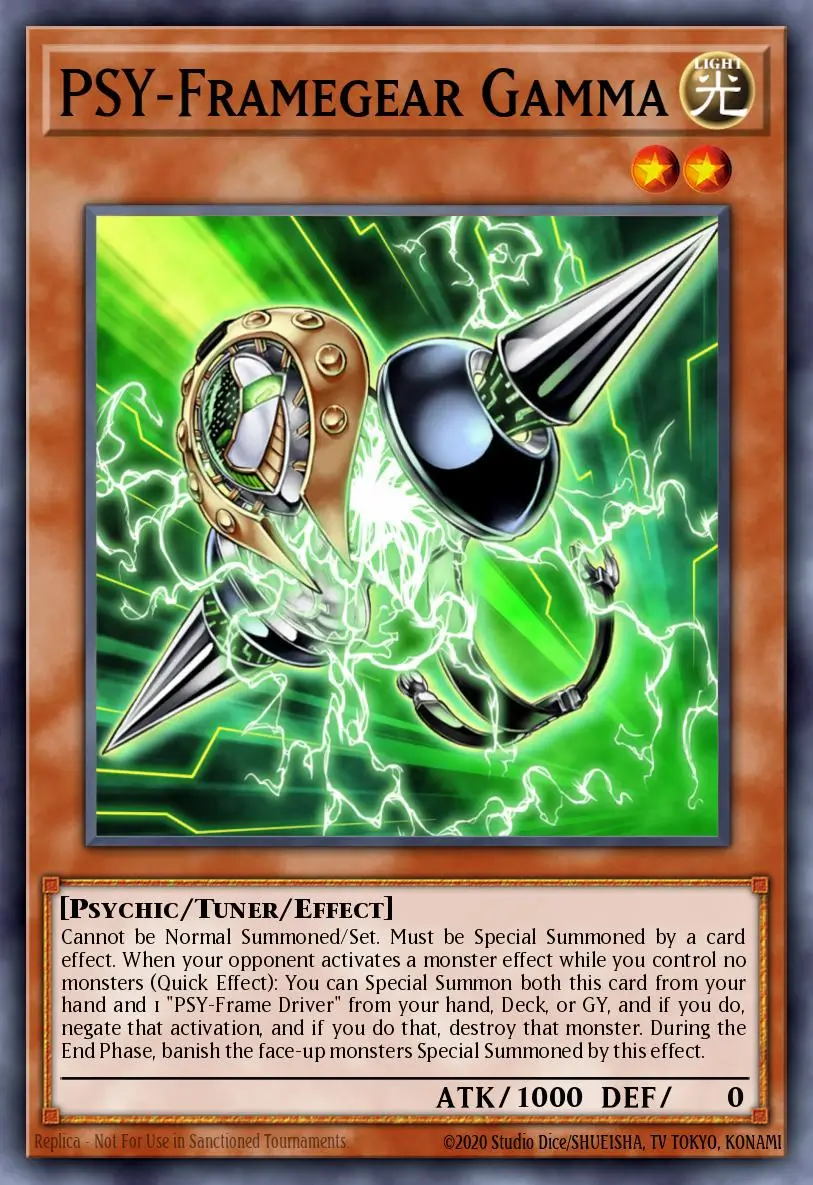
PSY-Framegear Gamma
Archetype:
PSY-Frame
ATK:
1000
DEF:
0
View:
13665
Cannot be Normal Summoned/Set. Must be Special Summoned by a card effect. When your opponent activates a monster effect while you control no monsters (Quick Effect): You can Special Summon both this card from your hand and 1 "PSY-Frame Driver" from your hand, Deck, or GY, and if you do, negate that activation, and if you do that, destroy that monster. During the End Phase, banish the face-up monsters Special Summoned by this effect.


PSY-Framegear Gamma — Power Evaluation
Final Score: 74 ± 5 · Confidence: Medium
- Intrinsic: 76 · Deck: 76 · Meta: provisional
- Primary role: Hand trap · Secondary: Negation/Interaction, Material body
Why it scores here
PSY-Framegear Gamma is a specialized hand trap that negates opponent monster-effect activations while you control no monsters, destroying the negated monster and summoning itself plus PSY-Frame Driver—generating 2 bodies and hard disruption in a single activation. Its strength lies in resource efficiency and flexible negation in going-second scenarios, though the empty-board requirement limits effectiveness in first-turn strategies where you've already built board presence. Across 122 distinct archetypes and 400 consistent decks, it maintains reliable 1-copy inclusion, with high synergy in Tuner-heavy lines like Kewl Tune where it serves as both interaction and Synchro material. The Limited-to-1 banlist restriction and mandatory PSY-Frame Driver pairing represent modest deck-building costs that do not undermine its role as a versatile and efficient hand trap.
Axis scores
| Axis | Score | Evidence |
|---|---|---|
| Accessibility | 75 | Hand trap that activates from hand when opponent triggers monster effect and you control no monsters; runs at 1 copy in 395 of 400 decks (98.75%), making it accessible when included (observed from deck statistics). |
| Combo & Conversion | 65 | Generates 2 summoned bodies (Gamma + Driver) plus 1 negated and destroyed opponent monster, appearing in combos with average power index 88.5; role is primarily reactive rather than active combo engine, with mixed starter/end-hand distribution (observed from combo examples). |
| Resource Economy | 70 | Each activation trades 1 hand card for 2 bodies plus negation and destruction of opponent resource, yielding approximately +1 card advantage on resolution, though both bodies are banished at end phase (inferred from card text). |
| Effect & Interaction | 78 | Quick-effect negation of any opponent monster-effect activation followed by destruction provides strong, flexible hard disruption; restricted to scenarios where you control no monsters, limiting going-first utility (verified from card text). |
| Material Utility | 72 | Level 2 Tuner type provides clean Synchro material even when effect is negated, with high synergy in Tuner-heavy archetypes like Kewl Tune (6.2% of deck sample), which guides identify as Synchro-focused (observed from deck distribution and guides). |
| Resilience & Flexibility | 65 | Survives in hand as a trap card; both summoned bodies are banished at end phase, preventing multi-turn board persistence or recursion, limiting resilience after activation (verified from card text). |
| Deck-Building Efficiency | 78 | Limited-to-1 across TCG, OCG, and MasterDuel; splashable across 122 archetypes with minimal garnet risk; requires PSY-Frame Driver (appears in 99.8% of co-decks) as a paired slot cost (observed from deck statistics and banlist). |
Calculation
Weight profile: Primary role Hand trap (A/C/R/E/M/F/D = 0.18/0.04/0.10/0.40/0.04/0.14/0.10). Intrinsic ≈ 76, Deck ≈ 76, Meta = provisional. Modifiers: Limited-to-1 banlist restriction (-2). Final formula: 0.40*Intrinsic + 0.60*Deck
Strengths
- Negates and destroys opponent monster-effect activation in a single card, providing both hard negation and removal in one action
- Generates 2 bodies (Gamma + Driver) on activation, providing resource generation and Synchro material for follow-up plays
- Splashable across 122 distinct archetypes, confirming broad accessibility and utility beyond just PSY-Frame decks
- Quick-effect timing allows activation on opponent's turn to chain to their plays before effects resolve
- Consistent 1-copy inclusion rate across 98.75% of sampled decks, indicating reliable slot efficiency and meta adoption
Weaknesses
- Empty-board requirement restricts activation in going-first strategies or when you've already developed board presence
- Limited-to-1 in all formats, capping potential redundancy despite high utility as hand trap
- Mandatory PSY-Frame Driver pairing creates a 2-card slot cost; both cards must be included to maximize effect value
- Both summoned bodies are banished at end phase, preventing persistent board contribution or multi-turn resource generation
- Thin combo sample (only 2 recorded combos) limits statistical confidence in performance within advanced combo synergies
Counters / choke points
- Monster effects that activate from field during the Summon process may not satisfy the activation timing of Gamma's quick effect
- Spell/Trap-based opponent strategies bypass Gamma's negation entirely, as it only responds to monster-effect activations
- Alternative hand traps like Ash Blossom & Joyous Spring (97.2% co-inclusion) and Droll & Lock Bird (87.8%) provide broader coverage in some metas
- Going-first decks that build board presence reduce the likelihood that Gamma can activate due to the empty-board condition
Best use
Hand trap negation; secondary Tuner material provider. Decks: Kewl Tune, PSY-Frame, Clown Crew, Synchro-heavy strategies, Going-second control. Suggested copies: 1.
Evidence & gaps
- Verified: Cannot be Normal Summoned; must be Special Summoned by card effect (card text); Limited-to-1 in TCG, OCG, and MasterDuel (banlist status); Quick-effect activation while opponent activates monster effect and you control no monsters (card text); Negates opponent monster-effect activation and destroys that monster (card text); Special summons both Gamma and 1 PSY-Frame Driver from hand, Deck, or GY (card text); Both summoned monsters are banished at end phase (card text); Level 2 Tuner-type monster (card type); Runs at 1 copy in 395 of 400 sampled decks (deck statistics); PSY-Frame Driver appears in 99.8% of co-decks with Gamma (deck statistics); Appears in 100% of 2 recorded combo examples (combo statistics)
- Observed: Appears in 122 distinct archetypes, with highest concentration in Kewl Tune (6.2%), Clown Crew (4.0%), and PSY-Frame (3.8%) (deck archetype distribution); Average power index in combo appearances is 88.5, indicating strong synergy in recorded combos (combo statistics); 50% role as starter and 50% role in end-hand across 2 combo examples (combo role distribution); 97.2% co-inclusion with Ash Blossom & Joyous Spring, suggesting pairing with other hand traps (deck statistics); 59.2% of sampled decks are going-first (Gameplay Type 7), 29.8% going-second (Type 6), indicating broad meta presence (deck gameplay distribution)
- Inferred: Quick-effect timing allows chaining to opponent plays before effects resolve, enabling reactive disruption; 2-body generation (Gamma + Driver) provides resource advantage and Synchro material on single activation; Approximately +1 card advantage on resolution (2 bodies + negate/destroy vs 1 hand slot); Tuner typing provides Synchro material value even when card effect is negated or blocked; Empty-board requirement limits utility in going-first strategies or when player has already built board; Splashability across 122 archetypes suggests hand-trap negation role is universally valuable despite specific activation conditions
- Data gaps: Only 2 combos recorded; insufficient sample size to establish robust combo-performance patterns or variance No top-card ranking data available; cannot corroborate competitive meta performance at high level Deck evidence not stratified by format; meta may differ significantly across TCG, OCG, and MasterDuel No archetype-specific performance metrics; cannot determine if Gamma drives adoption or is pure tech inclusion Missing counter/matchup-specific data; cannot assess performance against particular meta decks or strategies Guide mentions not analyzed in depth; cannot determine specific use-case recommendations beyond Staple categorization